


15th May, 1944, article on page 3.

15th May, 1944, article on page 3.

25th May, 1945, article on page 18.


Edwin James Dobson
Service No.: 5570141
Ship Assignment: USS LST-531
Edwin James “Jimmie” Dobson was just 17 years old when he lost his life during the Exercise Tiger disaster on 28th April 1944. Serving as a Seaman First Class in the United States Navy, he was aboard USS LST-531 when the landing ship was torpedoed by German E-boats in the English Channel approaches to Lyme Bay, off the coast of southern England. [1][2][3]
A young sailor from the United States, Edwin had entered the Navy only months earlier. His service took him from Florida to the waters off the English coast, where Allied forces were preparing for the invasion of Normandy. He would never return home. [3][4]
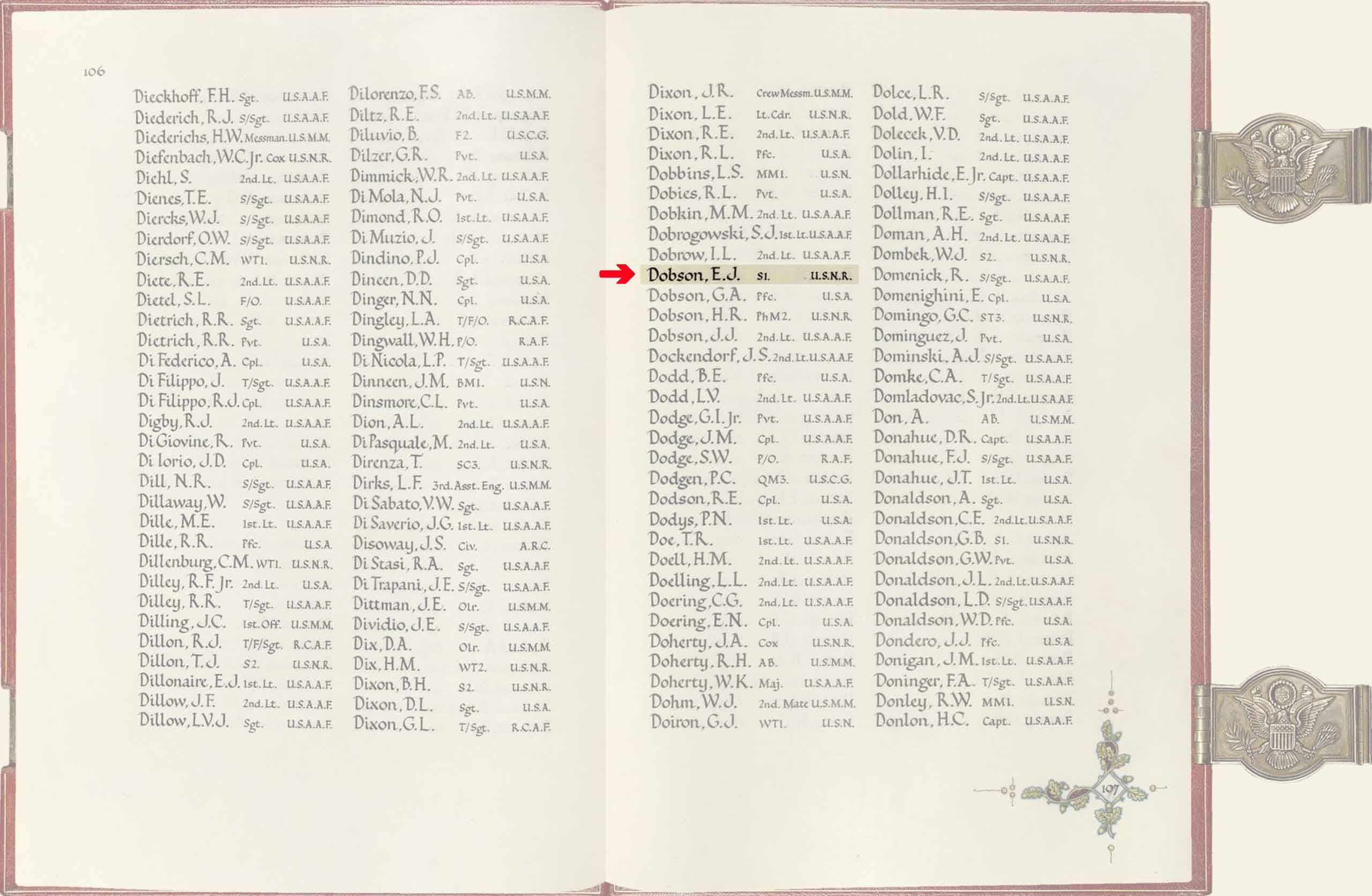
Today, his name is remembered on the Exercise Tiger Trust’s Roll of Honour and at the Normandy American Cemetery and Memorial in France, where he is commemorated among the missing. The American Battle Monuments Commission record identifies him as a Seaman First Class, gives his service number, and lists the Purple Heart. [1][5]
Behind the military records and memorial inscriptions was a young man whose life had barely begun. Known as “Jimmie” in family information associated with his story, Edwin James Dobson deserves to be remembered not simply as one of the casualties of Exercise Tiger, but as a son, a young sailor, and an American who gave his life during the Second World War. .Personal Information
- Full name: Edwin James Dobson
- Known as: “Jimmie”
- Other recorded names: Edwin J. Berry; Edwin James Berry, Jr.
- Rank: Seaman First Class (S1c)
- Service branch: United States Navy
- Service number: 5570141
- Ship assignment: USS LST-507
- Date of birth: 10th August 1926
- Date of loss: 28th April 1944
- Age at death: 17
- Place of birth: Pierce County, Georgia, USA
- Mother: Edna Josephine “Edna Joe” Lide, later recorded as Edna Berry Dobson
- Father: Edwin James Berry
- Entered service from: Jacksonville, Florida
- Ship: USS LST-531
- Memorial: Tablets of the Missing, Normandy American Cemetery and Memorial, France
- Award: Purple Heart
[1][3][5]
Early Life
Edwin James Dobson was born on 10th August 1926 in Pierce County, Georgia. Family and genealogical information associated with his story identifies his parents as Edwin James Berry and Edna Josephine “Edna Joe” Lide. [6]
The records also associate him with the names Edwin J. Berry and Edwin James Berry, Jr. These variations are important to his story, as they help explain why information about him may appear under different surnames in family records and historical databases. The principal naval casualty records use Dobson, while the supplied family information connects him with the Berry name. [3][6]
The available information points to these names being associated with the same young man, although the precise circumstances behind the surname difference would benefit from confirmation through original civil or family records.
The surviving record offers only a limited view of Edwin’s childhood and family life. It does, however, preserve his birth in Georgia and his connection to Florida, from which he entered naval service. [3][5]
It is easy, when reading a casualty list, to see only a name, a service number and a date. But Edwin was still in his teens. He had family ties, a life before the Navy, and years of possibility ahead of him. His story reminds us that the men lost during Exercise Tiger were young people with lives and futures of their own.
Military Service
Edwin enlisted in the United States Navy on 14th August 1943 in Jacksonville, Florida, just four days after his seventeenth birthday. His service number was 5570141. [3][4]
His early naval records place him at the Air Technical Training Unit in Jacksonville, Florida, where he was recorded as a Seaman Second Class. A change-of-status entry dated 28 October 1943 refers to Naval Training Station Bainbridge, Maryland. [4]
By January 1944, Edwin had joined the crew of USS LST-531. The ship’s records show that he was received aboard on 15th January 1944, having come from a receiving station in New Orleans, Louisiana. A subsequent report of changes records his advancement to Seaman First Class, effective 1st April 1944. [4]
These records trace the progress of a young sailor who had been in the Navy for less than a year. From his enlistment in Florida, through training and onward to his ship, Edwin was part of the naval force preparing for the largest amphibious invasion in history.
His service aboard LST-531 would bring him into the events of 28th April 1944, when the ship was lost during Exercise Tiger. [2][3]
USS LST-531
USS LST-531 was a tank landing ship built to carry troops, vehicles and equipment for amphibious operations. Ships of this type were central to Allied plans for landing forces across the English Channel and establishing a foothold in occupied Europe. [2]
LST-531 was commissioned in early 1944 and was among the landing ships assigned to training operations preparing American forces for the invasion of Normandy. [2]
By April, Edwin was serving aboard her as a Seaman First Class. His name appears in the ship’s muster-roll information and in Exercise Tiger casualty listings. [1][3][4]
The ship’s role was part of a much larger Allied undertaking. Thousands of servicemen were preparing for the dangerous crossing to France, where success would depend on the coordinated movement of troops, landing craft, naval escorts and supplies.
The loss of LST-531 during Exercise Tiger was therefore not only the destruction of a naval vessel. It was the loss of a ship and many of the men who crewed her, including a 17-year-old sailor from the United States.
Exercise Tiger
In the spring of 1944, Allied forces were preparing for Operation Overlord, the invasion of German-occupied Normandy. Exercise Tiger was one of the major rehearsals intended to prepare American troops and naval personnel for the landings. [2][7]
The exercise took place around Slapton Sands and Lyme Bay in southern England. It was designed to make the preparations for the invasion as realistic as possible, with landing ships and troops operating together in conditions intended to reflect the coming assault. [2][7]
During the night of 27th–28th April 1944, Convoy T-4 was attacked by German E-boats. The fast German torpedo boats penetrated the Allied convoy in Lyme Bay. USS LST-507 was torpedoed first; LST-531 was struck soon afterwards and sank rapidly. A third landing ship, LST-289, was damaged but survived. [2][7]
The attack caused devastating losses among the American servicemen aboard the landing ships. Edwin James Dobson was among those lost when LST-531 sank. [1][3]
He was only 17 years old.
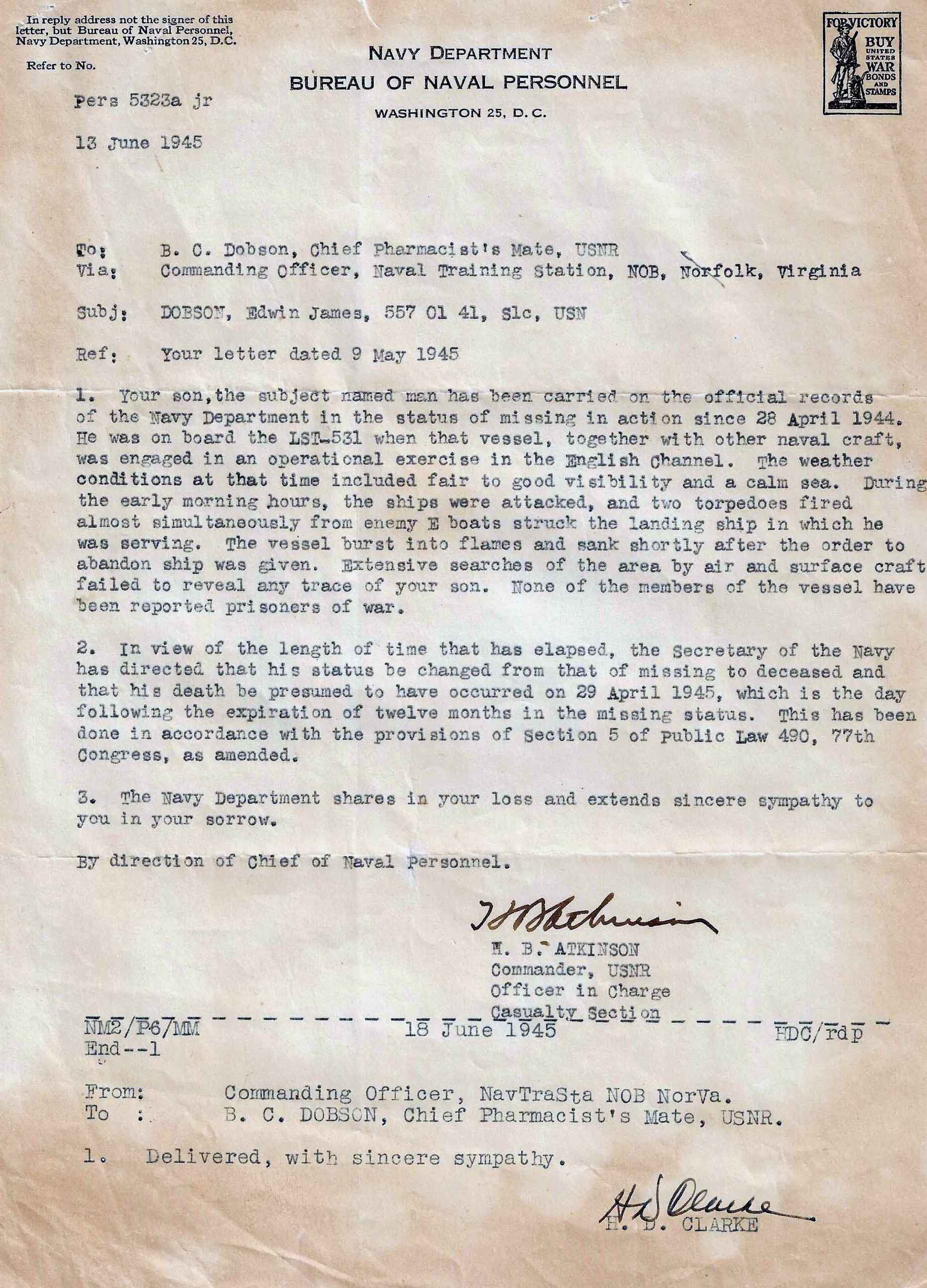
The precise details of Edwin’s final moments have not been established by the records consulted for this biography. It would be wrong to invent an account of his last actions or to suggest that we know what he experienced as the ship was struck. What can be stated is that he was serving aboard LST-531 and was recorded as missing following the attack on 28th April 1944. [3]
Exercise Tiger had been intended to help prepare Allied forces for the liberation of Europe. Instead, the events of that night brought tragedy to American families. The men who died were separated from their homes and loved ones by an ocean, and many were never brought home for burial in a known grave.
Edwin’s loss is a reminder that the history of Exercise Tiger is not only a military story. It is also a story of individual lives interrupted, of families left waiting for news, and of young men who never had the opportunity to see the peace for which they were preparing.
Missing in Action
Following the sinking of LST-531, Edwin was recorded as missing in action. A notice concerning his status appeared in the Florida Times-Union of Jacksonville on 15th May 1944, according to the research information supplied for this profile. [8]
For families of missing servicemen, the absence of a body or a confirmed account of death could leave painful uncertainty. Naval and military authorities had to establish the fate of those who had disappeared during the attack, and missing personnel could later be formally declared dead.
Edwin’s official records preserve two dates that should be understood in this context.
28th April 1944 is the date of the Exercise Tiger attack and his loss aboard LST-531. 29th April 1945 appears in casualty and memorial records as the date he was formally declared dead. [3][5]
The later date should not be confused with the date of the disaster itself. The distinction is important for anyone researching Edwin James Dobson, as different official databases may display one date or the other depending on the purpose of the record.
Although his fate was eventually formally recognised, Edwin’s name remains among those commemorated as missing. His memorial in France marks the loss of a young sailor whose remains were not returned to his family for burial in a known grave. [5]
Purple Heart and Other Awards
Edwin James Dobson was awarded the Purple Heart, a United States military decoration associated with those killed or wounded in service as a result of enemy action or other qualifying circumstances. The American Battle Monuments Commission record supplied for this biography lists the Purple Heart. [5]
His service is also associated in the supplied research with the American Campaign Medal, the European-African-Middle Eastern Campaign Medal, and the World War II Victory Medal. These additional awards should be checked against an official service or award record before each decoration is presented as independently confirmed. [6]
The Purple Heart is particularly significant to Edwin’s story. It stands as formal recognition of the loss he suffered in the service of his country during the Second World War.
Memorial and Commemoration
Edwin James Dobson is commemorated at the Normandy American Cemetery and Memorial in France, where his name appears among the missing. [5]
The cemetery overlooks the coast where Allied forces landed on D-Day, 6th June 1944. It is a place of remembrance for thousands of American servicemen who died in the liberation of Europe. The Tablets of the Missing honour those whose remains were never recovered or whose final resting places could not be identified. [5]
For Edwin, the memorial stands far from the Georgia birthplace recorded in his family history and the Florida community from which he entered naval service. It nevertheless ensures that his name is preserved among the Americans who lost their lives in the war.
Exercise Tiger Trust Roll of Honour
His name is also recorded on the Exercise Tiger Trust’s Roll of Honour, which remembers those who died during the disaster of 28th April 1944. The Trust’s collection of photographs of LST-531‘s crew includes an entry for Edwin J. Dobson, providing a further link between the casualty record and the ship on which he served. [1]
Exercise Tiger Memorial, Torcross, Devonr
Edwin James Dobson’s name is also commemorated at the Exercise Tiger Memorial at Torcross, overlooking the coast of South Devon. The memorial stands in remembrance of the servicemen who died during the Exercise Tiger tragedy and provides a lasting place for reflection and tribute.
American Memorial Chapel, St Paul’s Cathedral, London
Stanesic is listed in the American Memorial Chapel Roll of Honour at St Paul’s Cathedral in London. The chapel commemorates American servicemen who died while serving in the Second World War, providing a further place where his name is preserved.
These memorials help keep his story alive. They remind us that the men lost during Exercise Tiger were not simply figures in a wartime report. They were individuals, each with a name, a family, and a life that mattered.
Remembering Edwin James Dobson
Edwin James “Jimmie” Dobson was 17 years old when he was lost aboard USS LST-531 during Exercise Tiger. He had entered the United States Navy only months earlier and was serving at a moment when Allied forces were preparing for the invasion of Normandy. [2][3][4]
His life was cut short in the English Channel, far from the places associated with his birth and family. The surviving records cannot tell us everything about the young man he was, or fully convey what his loss meant to those who knew him. They do, however, preserve his identity, his naval service, and the circumstances in which he disappeared.
His story deserves to be remembered with the same care given to the better-known events of the Second World War. The tragedy of Exercise Tiger is measured not only in ships sunk and casualty totals, but in the lives of the individuals who never returned.
At the Normandy American Cemetery and Memorial, his name stands among those whose final resting places remain unknown. On the Exercise Tiger Trust’s Roll of Honour, he is remembered among the men lost on 28th April 1944. [1][5]
Edwin James Dobson was a son, a young American sailor, and a 17-year-old whose future was taken from him during preparations for the liberation of Europe.
He is remembered with honour.
Sources and References
[1] Exercise Tiger Trust — Roll of Honour and LST-531 Crew Photographs
Roll of Honour
LST-531 Crew Photographs
Records Edwin Dobson as an Exercise Tiger casualty and includes an entry for him among the LST-531 crew.
[2] US Naval History and Heritage Command — USS LST-531
naval-history.mil
Ship history, including the sinking of LST-531 during the German E-boat attack on 28th April 1944.
[3] Naval-History.net — US Navy Casualties by Name, Dobson
naval-history.mil
Lists Edwin J. Dobson, service number 5570141, aboard LST-531, missing following the loss on 28th April 1944 and later declared dead on 29th April 1945.
[4] US National Archives — Navy Muster Rolls and Personnel Records
Navy muster-roll guidance
The research supplied for this biography includes muster-roll records for the Air Technical Training Unit in Jacksonville and USS LST-531, documenting his enlistment, training, transfer, receipt aboard ship and advancement in rating.
[5] American Battle Monuments Commission — Normandy American Cemetery and Memorial
Navy muster-roll guidance
The ABMC record supplied for this biography identifies Edwin J. Dobson, service number 5570141, Seaman First Class, US Navy, entered from Florida, commemorated at Normandy American Cemetery and awarded the Purple Heart. It gives 29th April 1945 as the date of death, reflecting the later official status date rather than the date of loss during Exercise Tiger.
[6] Family and genealogical research supplied for this biography
Includes the name variants Edwin James Dobson, Edwin J. Berry and Edwin James Berry, Jr.; family names; birth details; and additional medal information. These details should be cross-checked against original civil, family and service records wherever possible. Ancestry may be useful for further investigation: www.ancestry.com
[7] US Naval History and Heritage Command — Exercise Tiger
history.navy.mil
Historical context for Exercise Tiger and the attack on the Allied convoy in Lyme Bay.
[8] Florida Times-Union, Jacksonville, Florida, 15th May 1944, page 3
A missing-in-action notice is identified in the research supplied for this biography. The original newspaper page has not been independently inspected for this draft; its wording should be checked before direct quotation.
[9] Exercise Tiger Trust — Declassified Report, 30th April 1944
Report Page
Contemporary report concerning the convoy attack and the loss of LST-531.
[10] Access Genealogy — Florida World War II casualty list, D surnames
accessgenealogy.com
Secondary casualty-list resource with information associated with Edwin James Dobson and his mother, Edna Berry Dobson.
Research Notes and Record Discrepancies
Date of loss and date declared dead:
The Exercise Tiger disaster occurred on 28th April 1944. The date 29th April 1945 appears in naval casualty and ABMC records as the date Edwin was formally declared dead. These dates should be retained with their different meanings clearly explained. [3][5]
Name and surname variation:
Naval records use Edwin J. Dobson, while family information supplied for this profile also associates him with Edwin James Berry and Edwin James Berry, Jr. The available evidence suggests these names refer to the same individual, but the reason for the surname difference has not yet been established from original civil records. [3][6]
Age:
His supplied date of birth, 10 August 1926, and date of loss, 28 April 1944, establish that he was 17 years old.
Enlistment and service:
The supplied records give an enlistment date of 14 August 1943 in Jacksonville, Florida; receipt aboard USS LST-531 on 15 January 1944; and advancement to Seaman First Class effective 1 April 1944. The original muster-roll images should be retained as supporting evidence. [4]
Selective Service registration card:
No registration card has yet been located. As Edwin died before his eighteenth birthday, he may not have registered under the process for men registering upon reaching that age. This is a plausible explanation, not proof that no card exists.
Awards:
The ABMC record supplied for this biography lists the Purple Heart. Other medals appear in the research notes but should be confirmed through an official award or service record before being presented as independently verified. [5][6]
Research status:
The core facts of Edwin’s naval service, service number, ship assignment, date of loss and memorial are supported by the sources identified above. Further research into the original newspaper notice and civil records may help resolve the remaining questions.
